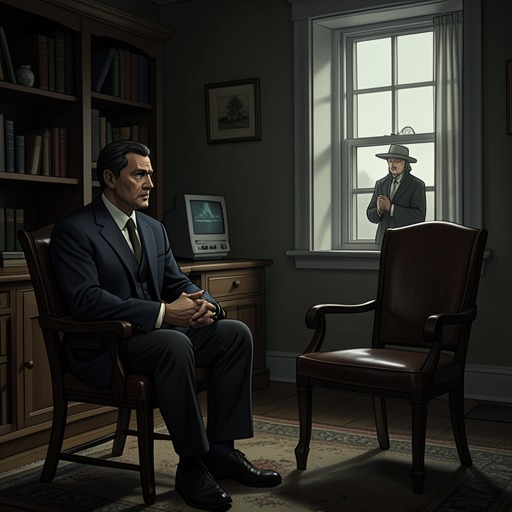
J. Robert Oppenheimer—Ella Oppenheimer relationship
American PrometheusJ. Robert Oppenheimer’s relationship with his mother, Ella Oppenheimer, was one of the most intimate and formative bonds of his childhood, but it was not simply a story of comfort. Ella’s grief and vigilance fostered a sheltered life in which her son adored her while gradually feeling constrained by her standards. His difficulty separating from her later surfaced in the image of a son wrenching himself free, and in a friend’s interpretation of the boy’s silence about his mother and criticism of his father.
A Childhood Shaped by Loss and Protection
Four years after J. Robert Oppenheimer’s birth, Ella Oppenheimer gave birth to another son, Lewis Frank Oppenheimer. The infant soon died from stenosis of the pylorus, a congenital obstruction between the stomach and small intestine. The loss left Ella seeming physically more fragile, and her surviving child’s frequent illnesses intensified her fear for him. Concern about germs became a pattern of practical restrictions: J. Robert Oppenheimer was kept apart from other children, forbidden to buy food from street vendors, and spared the barbershop when Ella arranged for a barber to come to their apartment.
That care made the home a protected space, but also narrowed the child’s ordinary contact with the world. Introspective and not athletic, J. Robert Oppenheimer spent his early years in what the account characterizes as the comfortable loneliness of his mother’s nest on Riverside Drive. Ella Oppenheimer encouraged him to paint landscapes, though he abandoned painting when he went to college. His devotion to her was profound; the account says that he worshipped her. At the same time, her rules shaped what could be acknowledged at home. A family friend recalled that Ella Oppenheimer would not allow anything unpleasant to be mentioned at the table, an atmosphere that made emotional restraint part of domestic life.
A Bond of Love and Strain
The relation between mother and son carried both attachment and pressure. The account describes their connection as intense, and J. Robert Oppenheimer’s childhood deference to Ella Oppenheimer did not mean that separation was easy. Her protectiveness answered genuine bereavement and worry, yet it also kept him dependent on the carefully managed world she created. The text does not present a decisive break in childhood; instead, it traces the difficulty through small constraints and later recollections.
One revealing contrast concerned the parents’ social temperaments. Ella Oppenheimer was quiet and emotionally delicate; Julius Oppenheimer was outgoing and spontaneous. J. Robert Oppenheimer sensed that his mother disapproved of the people in Julius Oppenheimer’s business world, many of them first-generation Jewish immigrants, and of what she regarded as their obtrusive manners. He therefore grew up pulled between her strict standards and his father’s gregariousness. He could feel ashamed of Julius Oppenheimer’s spontaneity, then guilty for feeling ashamed. The tension was not evidence that he lacked love for either parent; it shows how difficult it was for him to reconcile their different worlds while remaining close to both.
Separation and the Image of Coriolanus
As an adult, J. Robert Oppenheimer gave his former teacher Herbert Winslow Smith an engraving depicting a scene from Shakespeare’s Coriolanus: the hero unclasping his mother’s hand and throwing her to the ground. Herbert Winslow Smith was sure that the gift conveyed something about how difficult J. Robert Oppenheimer had found it to separate from his own mother. The image gave dramatic form to a struggle that the childhood record presents more quietly: attachment to Ella Oppenheimer coexisted with the need to become independent of her.
The engraving should not be mistaken for proof that J. Robert Oppenheimer rejected his mother. The evidence instead holds together his adoration and his difficulty separating from her. Its force lies in that contradiction: a literary image of violent release chosen by a son whose early bond with Ella Oppenheimer had been exceptionally close.
Smith’s Reading of the Family Dynamic
During a later camping trip, Herbert Winslow Smith interpreted J. Robert Oppenheimer’s family relationships through the Freudian ideas of child development with which he was familiar. From their relaxed campfire conversations, Herbert Winslow Smith concluded that the boy had pronounced oedipal issues. He recalled hearing no criticism of Ella Oppenheimer from J. Robert Oppenheimer, while hearing enough criticism of Julius Oppenheimer. This was Smith’s interpretation, not an independently established diagnosis; the account presents it as one observer’s attempt to understand a sensitive child’s attachments.
Herbert Winslow Smith also connected the family dynamic to J. Robert Oppenheimer’s broader vulnerability. He had known him since he was fourteen and regarded him as physically delicate and emotionally exposed. Smith thought that episodes of colitis tended to occur when someone made disparaging remarks about Jews, and suspected that J. Robert Oppenheimer dealt with intolerable facts by pushing them aside. These observations do not reduce the mother-son bond to a clinical explanation. They do, however, place it within a childhood in which illness, Jewish identity, parental differences, and emotional reticence could become entangled. The relationship’s lasting significance rests in that combination: Ella Oppenheimer’s care made her central to her son’s inner life, while the intensity of that bond made separation a challenge he continued to recognize as an adult.